Desert Inspiration

“May your trails be crooked, winding, lonesome, dangerous, leading to the most amazing view.”
Edward Abbey, Desert Solitaire

I suspect the pictures on this website have already given you a clue, but yes, you're right, I do have a bit of a thing about deserts...
I was originally drawn to these extraordinary landscapes by their remote otherworldliness, but soon discovered the peculiar flora and fauna that thrive there.

Take the stately Saguaro cactus, for example; these magnificent plants can grow as tall as a two-storey building, their enormous arms reaching out in every direction. Some don't develop their first arm until they're several decades old, and they can live for well over 150 years.

The fairy-tale Ocotillo looks rather like the tendrils of very tall underwater reeds, swaying in the breeze. Its slender stems are tipped with vibrant tongues of red or pink flowers, reaching into the air as though floating effortlessly, almost entirely devoid of gravity.

Then there's the crisp, lime-green Prickly Pear, unashamedly sporting a crown of colourful flowers in spring and delicious fruits in summer. Even its fleshy pads, known as nopales, are edible and feature regularly in Tex-Mex cooking.
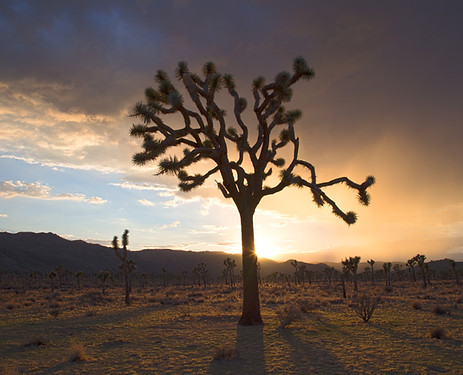
But the king of the weird and wonderful must surely be the quirky Joshua Tree. A member of the yucca family, its wonderfully eccentric silhouette seems almost too improbable to be real. I love it so much that I left a little of my heart in Joshua Tree...
I'm genuinely moved by the extraordinary variety of shapes, colours and textures found in deserts. It's difficult to explain, but ultimately I'm humbled by the ingenuity of plants and creatures that have evolved to survive in these seemingly inhospitable landscapes. Even the smallest plant or creature fills me with admiration and wonder.

And that brings me to the Cholla cactus (pronounced Choy-uh), which has a fascination all of its own.
Found throughout the deserts of the American Southwest, some varieties of Cholla have a deceptively soft, almost furry appearance. The aptly named Teddy Bear Cholla is particularly irresistible in the right light, its branches seemingly covered in delicate, silvery fur.
But don't be fooled! Those soft-looking hairs are actually formidable spines, armed with microscopic barbs. Certain varieties are even known as Jumping Cholla, because their loosely attached branches catch onto anything that brushes against them. The result can be an extraordinarily painful encounter. Admire from a distance — you have been warned!

When a Cholla reaches the end of its life, fallen branches gradually dry and decay beneath the desert sun. Eventually, their outer layers disappear, leaving behind extraordinary wooden skeletons, twisted and weathered, punctuated by elongated holes in an intricate lattice of natural forms. These skeletal remains were little desert jewels to me from the moment I discovered them. But respecting the 'take only photographs, leave only footprints' principle, I could do no more than admire them, photograph them and dream about their shapes.
In time, those memories and photographs inspired my first Cholla Cigar Ring, and the collection began to grow. Creating the Cholla Collection has become a way of expressing my enduring fascination with these extraordinary landscapes, and of keeping a little of the desert with me, even when I'm home.